Thursday, January 4, 2018

Overtraining and Heart Rate Variability (HRV)- Part I

I'm pretty sure most of you know what overtraining is?  Maybe you've experienced it.  Maybe not.  If not, here are the symptoms:

  • Persistent muscle soreness
  • Elevated resting heart rate
  • Increased susceptibility to infections
  • Increased incidence of injuries
  • Irritability
  • Depression
  • Loss of motivation
  • Insomnia
  • Decreased appetite
  • Weight loss
As an engineer, I wanted a more scientific way of measuring or diagnosing overtraining.  They (the experts) say when you overtrain, your resting heart rate increases (or is elevated).  I'm sure that's true.  The problem with measuring resting heart rate is that there are too many variables that can affect it from day-to-day such as: diet, amount of sleep, stress, time of day, position (sitting, lying, etc) you're in when taking resting heart rate, the monitoring device (heart rate monitor), etc. What I found is a better indicator of overtraining is Heart Rate Variability (HRV).  

Heart Rate Variability (HRV) is the variation in time between successive heart beats over a given period of time.  The time between beats is called R-R intervals measured in milliseconds.  The time between intervals, unbeknownst to me, is not constant.  That is, if your resting heart rate is 50bpm your heart doesn't beat 50 times in a minute at exactly 1 second intervals each time.  I thought it did. Sometimes it beats less than a second apart and sometimes it beats more than a second apart..just like the diagram above (0.97s between beats and 1.1s between beats).   But, the average over a minute period of time is one second between intervals. Why is that?  It's due to your Autonomic Nervous System (ANS).  Your ANS controls your nerves, muscles, glands, etc.  The ANS touches every process within your body.  It affects blood sugar, adrenaline, digestion, pupil dialation, heart rate and much more.  The ANS has two systems or branches: the Sympathetic Nervous System (SNS) and Parasympathetic Nervous System (PNS).  The PNS is your "rest and digest" branch and is responsible for muscle repair, decreased heart rate and lowering blood pressure.  The SNS branch is your "fight or flight" branch and is responsible for increased heart rate, increasing blood pressure, dilating pupils, making you sweat, etc.  Obviously, you want your ANS leaning towards the PNS branch..otherwise you'd be like a cat in a room full of rocking chairs- a nervous Nelly.  However, when it's time to perform, you want your SNS branch to kick in and take over and dominate.  So, the two branches are competing to keep you alive.  Thus, the changes in heart rate and Heart Rate Variability (HRV).  These changes are the ones we want to measure to help us determine if we're overtraining or not.

How do we measure HRV?  You can measure it with a good Heart Rate Monitor, such as the Polar H7 or H10 Bluetooth HRM and an App for your smartphone called "Elite HRV" which I highly recommend.  You can get the Polar H7 HRM online for $50 or the H10 for $85.  The Elite HRV App is FREE.

See Part II (coming soon) for a description of the Polar H7 HRM and the Elite HRV App.  Until then, Power ON!  Coach Rob

Sunday, December 31, 2017

Happy New Year 2018


If you're looking to get in shape for 2018..make sure you set a goal (or have a plan) and that it's measurable. i.e. lose 20 lbs. in 8 weeks.  Increase my FTP by 25 watts by April, etc. Also, make sure you have the discipline, willing to sacrifice, and have the motivation to stick with your goal/plan.  Otherwise, it aint goin' to happen.  Wishin' (or dreaming) you get in shape will never happen on it's own.  You have to want it and you have to do it.  Just do it.  Good Luck!  Power ON!  Coach Rob

Happy New Year everyone.  Looking forward to a healthy & happy 2018.

Thursday, December 28, 2017

Pedal Stroke Explained

I don't think most people think about their pedal stroke when they ride their bike and I suppose unless you're racing or logging a lot of miles as a recreational rider- who cares.  I can't tell you how many times I ride behind recreational riders and notice they're bouncing in their seat because the seat is too high or their knees are pointed outwards like they're riding a beach cruiser at the shore wearing flip flops.  I don't even want to mention their pedal stroke..because it's all over the place.  But, if you're racing or you're a recreational rider that logs some pretty long miles you'll not only want to be fitted properly to your bike, you want to ensure you're pedal stroke is as efficient as it can be.  By the way, if/when you buy a bike, you should have the bike fitted to you, not the other way around.

The best way to explain the most efficient pedal stroke is through this clock diagram (below).  I'll start with 12 o'clock.  At the top of the pedal stroke your foot should be at the same position as it is at 6 & 9 o'clock.  That is, the heel should be slightly elevated from the toe.  Your hip extensors or glutes are ready to kick in and drive the foot forward at the top.  At this position you'll feel the toes hitting the fronts of your shoes.  At 1 o'clock, your knee extensors, or quads, are ready to kick in and supplement the glutes.   The 2 o'clock position is the position of max power applied to the pedal because your glutes and quads (the biggest muscles) are both fully engaged. Your heel will drop down from its elevated position so that your foot is horizontal to the ground.  At the 3 o'clock position your foot will be horizontal and your heel may drop slightly below the toe level depending on the grade and/or how hard you're pedaling.  At the 4 o'clock position your glutes will acquiesce and let the quads takeover.  At 5 o'clock, or bottom of the stroke, your calves kick-in and takeover for the quads.  At 6-7 o'clock, your ankle dorsiflexor or shin muscles kick-in.  At this point you should feel like you're scraping mud from the bottoms of your shoes.  The hamstrings do all the work from 8-9 o'clock.  At this point you're actually pulling up slightly on the pedal (a lot if you're climbing).  You may not feel it but you are.  At 10 o'clock through 12 o'clock it's all hip flexor.  Again, you're pulling up slightly on the pedal.
Notice the foot position on the pedal is just about the same at the 6, 9 and 12 o'clock position.  Also, notice when pedaling correctly you're utilizing ALL of your leg muscles- front and back including the glutes.  You want good balance.  i.e. you don't want strong quads and weak hamstrings or glutes.  You want everything strong.


The Winter months are the months you want to work on pedaling efficiency.  One leg pedaling drills are probably a good idea to inject into your winter training plan/workouts.  You'll know if you have a good pedal stroke if it isn't jerky or erratic.  If it is, work on being smooth throughout the entire clock.

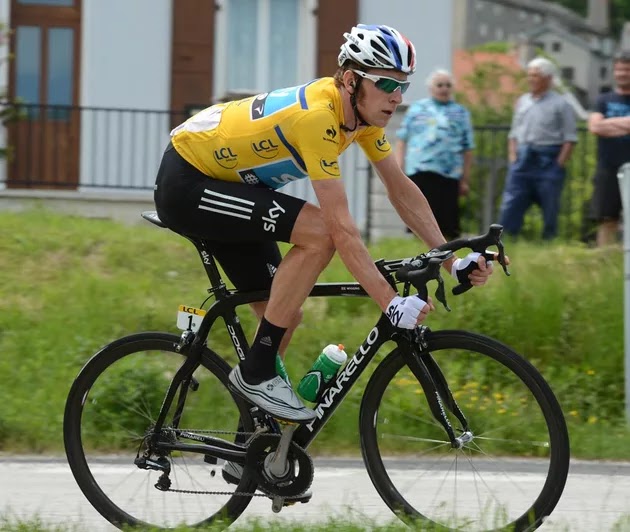
Check out the photo of Bradley Wiggins below.  Notice the foot position at 12 o'clock and 6 o'clock.  i.e. heel slightly elevated.  That's what I'm talking about.


Power ON!  Coach Rob

New Year, New You

It's that time of year again, the New Year, where resolutions are made only to see resolutions being broken/ignored.  Here are the top 5 New Years resolutions:


I agree, everyone could benefit or improve their lives from the Top 5 list.  But it's also a known fact 92% of  all New Years resolutions fail.

Why is that?  Why do 92% of all New Years resolutions fail?  The primary reason why resolutions are broken (or fail) is because either a) the goals were unrealistic or not specific enough to begin with.  i.e. goals need to be measurable, or b) there was no motivation or self-control to keep/maintain the goal or c) both a and b. 

Lets start with a). unrealistic or non-specific goals.  And, we'll use resolution #4 (as an example) which seems to be the number 1 New Years resolution on most peoples list.  Lose weight.  How much weight?  By what date?  How are you going to lose the weight?  Starve?  Exercise?  Eating Healthy?  Combination of eating healthy & exercising?  Ok, so you need to make a measurable goal.  How about losing 1 lb. per week for 20 weeks.  Or, I want to lose 10 lbs. by my wedding.  That's good, that's definable/measurable.  How are you going to do it?  By eating healthy and exercising.  Good.  Now, what's your motivation for meeting that goal?  You want to be healthy?  You want to look good?  Ok, good.  Now, the biggest impediment to meeting that goal is- what's your motivation?  Do you have a wedding?  Do you have a special event?  Is that enough motivation?  Do you have enough self-control throughout the dieting and exercising period to stay on track to meet the goal?  Do you have a support group?  That is why 92% of New Years resolutions fail.  People have the "desire" but they don't have the "motivation" or "self-control".  If you don't have the desire AND the motivation and self-control, it's never going to happen. 

I saw a great movie last night (true story), that I've seen probably a half-dozen times before, with Robert DeNiro and Cuba Gooding Jr. called, "Men of Honor".  In the movie, Cuba Gooding Jr. wants to become the first Black Master Diver in the US Navy.  That's his goal, his desire in life.  Robert DeNiro, who was the Master Chief running the Master Diver program for the US Navy asked Cuba Gooding Jr., "why do you want to be a Master Diver so much Cookie?".  (Cookies are newbie divers.)  Cuba Gooding Jr. responded, "I always wanted to be a Master Diver sir...and because they said I couldn't do it".  So, Cuba Gooding Jr. had the desire and he had the motivation..and guess what?  He became a master diver despite being black and having his leg amputated.  

So, before you make your New Years resolutions for 2018, don't think so much about the resolution goal, think more about how you're going to have enough desire, motivation and self-control to stay the course and meet that goal.

Good Luck in 2018 and Happy New Year.  Power ON!  Coach Rob

Wednesday, December 27, 2017

Fitness, Freshness & Form

Just wanted to highlight a BEFORE and AFTER Fitness, Freshness & Form chart from a ride on Zwift this morning.  This was the first time in a long time, my Form was actually a positive number.  (If you want more info on Form, search my blog).  Therefore, I should have been strong on my ride today.  I really didn't feel any stronger because I did nothing but eat/drink the last few days.  I know for a fact that I don't have good workouts after drinking copious amounts of beer like I did over Christmas.

BEFORE:

You can see that AFTER my ride, my Fitness increased by 1 point (supposedly it made me stronger, when in reality workouts make you weaker because of the micro-tears and muscle inflammation), my Fatigue increased by 9 points (which makes sense since I'm tired) and my Freshness decreased by 7 points (which also makes sense since I'm not fresh anymore).  My ride was a 45 minute virtual reality training ride on Zwift.  My average power for the 45 minutes was 190w.

AFTER:

Monday, December 25, 2017

Merry Christmas!


Merry Christmas everyone from our family to yours.


Looking like a White Christmas at my Pocono Home!

Fat America

For those that don't know me, or for those that haven't seen me in a while..I've lost 35 lbs. since last year this same time.  Last year, on Christmas Day, I weighed 195 lbs.  This year, I weigh 160 lbs.  That weight loss was due to me "getting back in shape". i.e. eating clean/healthy and exercising regularly by cycling 3-4x per week.  Although I don't look great (according to friends & family), I feel great.  Friends and family say I look sick and they're asking my wife if "I'm ok".  Yes, "I'm ok".  It's not like I haven't been here before.  When I was 50 yrs. old (I'm 58 now), I dropped from 220 lbs. to 195 lbs. then from 195 lbs. down to 175 lbs.  I stayed at 175 lbs. for 5-6 yrs. until I let it slip back up to 195 lbs. last year.  The reason?  For those years that I let my weight gain from 175 to 195 were the years I stopped riding my bike.  Not sure why I stopped..well I do somewhat.  I used to race my bike when I weighed 175 lbs. and then I crashed at a big race (that I trained over a year for) and wasn't able to finish.  I thought to myself, why am I doing this..training so hard and eating so clean only to crash in a race I prepared so hard for...for who..for what?  So, I gave up riding and racing altogether (and ate/drank whatever I wanted) which was pretty stupid because I lost all my fitness I worked so hard to obtain.  I just didn't care anymore.  I don't expect to race again anytime soon (although I did hear that USA Cycling may open up a 60+ Masters Category that has me thinking about it), I do expect to ride recreationaly in the future- this time for good.  I always want to continue to ride my bike- God willing.  There's just something about it..the free/liberating feeling of riding.  I still remember my first bike, at Christmas, almost 50 yrs. ago today.  It wasn't much of a bike.  It was a single speed stingray design from Sears second hand store called Cozi's. It had a banana seat, sissy bar, high handlebars, etc.  It wasn't even close to being as nice as my friends 5 speed Schwinn Orange Crush but it was mine.  When I rode it, I got that free liberating feeling.  I get the same feeling these days when I ride..whether it's my bicycle or my motorcycle.  Later, when I was 13, I received my first Schwinn 3 speed Varsity road bike on Christmas.  I was so proud of that bike.  I rode it every day even throughout the Winter.  So, for me, riding a bike has been a part of my life since I was 8.  Tricycles don't count- ha.

Out of curiosity I looked into the Body Mass Index (BMI) chart to see if my height to weight ratio was in the normal, underweight or overweight category.  I knew I wasn't in the overweight category.  According to Wiki:

"In 1998, the U.S. National Institutes of Health and the Centers for Disease Control and Prevention brought U.S. definitions in line with World Health Organization guidelines, lowering the normal/overweight cut-off from BMI 27.8 to BMI 25. This had the effect of redefining approximately 29 million Americans, previously healthy, to overweight.[20]

So, if you're BMI is over 25 you're overweight, over 29 obese.  Did you know that over 35% of Americans are "obese"?  Fat America for sure.  That's why when people look at my svelte physique they ask, "Is Rob ok?  Is Rob sick?".  No, he's not sick, you're just so used to looking at fat/overweight/obese people which seems to be the norm these days.  Here's the BMI chart with recommended guidelines:

For me, since I'm 5'11" and I weigh 160 lbs, my BMI (according to the chart) is 22.  That is near the middle of the green band.  Actually, it's closer to the overweight band (yellow) than the underweight (blue) band.  So, according to the National Institute of Health (and CDC), I'm where I should be- in the healthy range.  Are you?

Power ON!  Coach Rob 

Saturday, December 23, 2017

Power Meters and Triathlons

Saw a chart today from Alex Simmon's blog re: the usage of Power Meters at Kona's World Championship Ironman Triathlon.  Seems like the Triathlon people are slowly catching on to the benefits of a Power Meter.  At least the more experienced triathletes are. See chart below.


 So, why are they gaining in popularity?  Either these athletes have more disposable income these days or power meters are more affordable- or both.  I think it's more the latter.  Regardless, I think it's great.  When I was actively coaching both road cyclists and triathletes back in 2011, there were hardly any triathletes with power meters on their bikes.  Yes, I admit price was probably a deterrent since even in 2011 a decent power meter would set you back $700.  But, what I found more common was that they didn't know how to use them even when they were given one to demo.  That is why I joined Todd Wiley (TWiley Sports) for his annual Lake Placid Triathlon Camp in May.  I gave a presentation during the weekend camp on the benefits of power meters for triathletes.  One of the primary benefits to someone doing the Lake Placid Ironman is/was pacing themselves.  The Lake Placid course bike ride is 2 x 56 mile laps that are very hilly.  If you go out too hard on your first lap, you'll most likely cook yourself for the 2nd lap and more importantly wreak havoc on your marathon run.

Good stuff.  Glad to see it.  Power ON!  Coach Rob