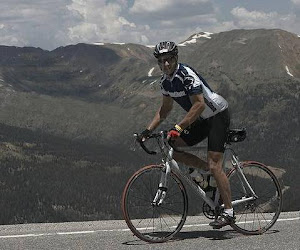
Most cyclists think the only way to do training intervals is inside on their trainer. That's not so. You can do intervals outside as long as you find a road/path where you have time/distance to perform a steady-state interval effort. That is, a road/path void of any stops. I have just that path/road. It's a canal/tow path near my home that runs adjacent to the Delaware River. It's flat, and at night, it's deserted. The only slow downs are 2-5 second slow downs for road crossings and/or bridge crossings. In the interval workout last night, I completed two intervals at L3/L4 (sweetspot) zones: the first being 25 minutes long and the 2nd being 45 minutes long. Each interval was separated by a 5 min. rest. The rest interval was when I dismounted my bike and walked across a Delaware River bridge (on the walking path). At the end of the 45 minute interval there was a 10' cooldown period Here's the workout:
5' Warmup
1x25'@L3/L4
5' RI (Rest Interval)
1x45'@L3/L4
10' cooldown
Here's what it looks like graphically:
What I really like about this graph is the W' curve (red line). It shows how my stress went from positive to negative during the interval workout. They (experts) say when your W' equals zero that you're nearly out of gas. That was true last night. In fact, I was running on fumes at the end of the 1st interval. The second interval was no different...running on fumes at the end of the interval. You can see how the 5' Rest Interval (RI) re-charged my batteries but that they were drained shortly thereafter- again. No doubt a good interval workout that stressed the legs. My legs were sore when I got home last night. In fact, they're still a little sore this a.m. Now, I need to get some rest and recover so the leg muscles can rebuild (stronger) and get ready for the next effort/workout on Sunday. Until then. Power ON! Coach Rob
Friday, December 8, 2017
Wednesday, December 6, 2017
Zwift
Ok, so I said whenever a cool product hits the market I would review it. Well, this product isn't necessarily new but it's new to me and it's WAY COOL! The program (or game) is called Zwift. What is Zwift? It's an online (internet) game, it's an interactive cycling software program, it's a training aid, and it's FUN! See www.zwift.com
What you need to set up Zwift is a bike, a cycling trainer with a power meter, a laptop or desktop computer and an internet connection. You can even run the Zwift program from a phone or iPad. That power meter can be built into the Hub of your wheel (provided it can communicate via Bluetooth or ANT+ protocol with the computer that the Zwift software is installed on), it can be a HR Monitor/Power Meter strap (such as the PowerCal from Power Tap), it can be a trainer such as Computrainer (by Racermate) or one by Cycleops or Tacx. The more accurate the power meter, the more realistic the online experience. The computer should have a good network or Wifi connection with hi-speed internet service. It should also have a fast graphics card/adapter. If not, the Zwift software program won't run properly or won't run at all.
Once set up on your computer you can go for a group training ride, sign up for a race, or just ride alone. The first thing to do, once you sign-on is to determine what your Functional Threshold Power (FTP) is. You can do that by clicking on the FTP test. You have the option of doing a 1 hr. FTP test or a 20 min. abbreviated FTP test. I chose the latter. Once you determine your FTP (mine was 210w when I tested it last night. My FTP is actually closer to 220w) you divide that number by your weight in kilograms. To do that, just weigh yourself in lbs. and divide by 2.2. I weigh 160 lbs. so my weight in kg is 160/2.2= 73kg. Now, take the FTP (210w) and divide that by the weight (73) and you get a power to weight ratio (w/kg) of 2.9 w/kg. If you want to race online, you need to know this number so you can ensure you sign up for the correct race. The races are rated/categorized A thru D. Here is the Zwift w/kg per race category:
A> 4 w/kg
B= 3.2- 4 w/kg
C= 2.5- 3.2 w/kg
D< 2.5 w/kg
Based on this, my w/kg was smack in the middle of the C-category. So, I entered a Cat-C race and I got shelled/dropped...ha. I could clearly see that the people ahead of me were not Cat-C riders, their w/kg was close to 4, some even over 4 w/kg. By the way, these people are real people from all over the world. So, just like in real life racing, there are sandbagger racers online. It's easier to sandbag at an online race than it is a real race. The easiest way to do it is to enter a weight (into the software program) lower than your actual weight. The other is to use a Power Meter that is not calibrated properly and reads high. I know that the PowerCal HR monitor/power meter reads 10% higher than my Computrainer Power Meter. I know Zwift is trying to police this somehow/some way. Here is a screen shot of a race:
The Zwift software tells you everything you want to know about the race/ride. It tells you your power output (watts), your Heart Rate (bpm), your cadence (rpm), your speed (mph), the distance and time into the race and the time remaining. It also tells you the other racers around you, their names, where they're from, their w/kg, etc.
All of this Fun is not free however. After your free 7-day trial, you must pay $15/mo. to continue. But, that's cheap considering one spinning session at your local gym where they play Beyonce music for 45 minutes charges $25. That's $15/mo. for unlimited riding, races, etc. Even if you only sign-up for the Winter months (December thru March) it's well worth it in my opinion. Because there is no better cycling training than racing.
Check it out, I think it's a cool program that's only going to get better. Power ON! Coach Rob
Thursday, November 23, 2017
Happy Thanksgiving!
Hope you all have a great Thanksgiving Day. Did you get a ride in today before the big dinner feast? I did. Now I won't feel as guilty downing all the food/drink. Don't forget, the average Joe gains 5-10 lbs. from Thanksgiving to New Years day. For me, it's a time of year I start watching what I eat because it's too easy to start drinking and eating too much. Every where you go over the Holiday's there's food- mostly junk food. So, riders beware! Don't forget to get a long ride in this weekend. It's supposed to be mild temps (50F ish).
PowerCal vs. Computrainer Power Output
Let me just say this before I begin, this post was not intended to compare the merits of a $100 power meter/HR monitor made by Power Tap to that of a $1500 power meter made by Racermater aka Computrainer. There is no comparison. What it's intended to do is show/highlight the PowerCal for what it is. That is, it's an inexpensive tool to get you into the "power meter" world without taking a 2nd mortgage out on your home. Just like you can go to a store and buy a $100 micrometer vs. $1000 micrometer, they both do the same job..measure things. It's just that one does it with better accuracy/precision than the other. Naturally, the higher the price the more accurate. Same applies with power meters.
From the research that I've done, I read/heard the PowerCal power meter/HR monitor has better reliability (closer accuracy) with longer steady-state efforts rather than shorter intervals. So, I set out to see if this was true, and lo and behold- it is/was. Granted, this is not a scientific study and the sample size is not large enough to give it any statistical significance. Nonetheless here it is. See Chart below:
You can see that as the intensity increases (L1 thru L4) the change in watts (delta) between the Computrainer and PowerCal increased. I can only assume that's because of the short 5 minute intervals. So, I decided to do a longer interval at L4 (20 minutes instead of 5 minutes). You can see that the delta decreased from 30 watts to 10 watts. That is, the PowerCal was more accurate at longer steady-state intervals. I tried to maintain the target watts of 225w at L4 but I could only muster 205w. Just not on my A-game since I rode hard on Tuesday night and it's currently Thursday night. Yeah, I know, it's 2 days..but I'm almost 60 and I seem to need 3 days rest before hard workouts rather than 2 of yesteryear.
I'm really happy with my PowerCal power meter/HR monitor for $100. It does what it was intended to do and that is get you in the ballpark of the power meter game. As I said before, it's not intended to compare with the more expensive power meters on the market, but it will get you in the game/ballpark..and that's what I wanted. If I want better accuracy I'll use one of my more expensive power meters on a ride- that has better accuracy.
BTW, I own 2 computrainer power meters at $1500 ea. (one is Lab quality), an iBike Pro power meter at $400, 2 Power Tap power meter hubs at $700 ea. And, now a PowerCal power meter/HR monitor. That's over $4000 worth of power meters. So, it's not that I don't have any other power meters or I can only afford a $100 power meter.
Power ON! Coach Rob
Blood Pressure & Pulse
One of the reasons why I ride is to stay healthy. I don't have to tell you that eating healthy and exercising is the key to good health- that and good genetics. Actually, it's better to have good genes than anything else. I've known many people to die early on in life from nasty diseases such as cancer, heart disease, etc. despite being in great physical shape. We have no control over the hand we were dealt re: genes, so it is what it is and you are what you are. For the things we do have control of- why not eat healthy and exercise?
As far as your heart goes, it's wise to keep track of your blood pressure and your pulse. I like looking at pulse as well as heart rate because it gives me a good indication of my current fitness. i.e. normally the lower the pulse the better shape (in younger people). There is a condition called bradycardia and it usually affects older adults (>65). Bradycardia is a deterioration of the electrical system of the heart. Bradycardia lowers the pulse rate in older adults. There are also many drugs out on the market place that lower pulse rate. When I'm not in shape, my heart rate/pulse is normally around 65bpm. When I'm in-shape it's generally in the mid to high 40s. Currently my resting pulse is 47bpm. This past May when I was out-of-shape my pulse was 65bpm. So, in 5 months I was able to lower my pulse (resting heart rate) almost 20 beats per minute due to eating healthy and exercising.
What's a normal heart rate/pulse? According to the Mayo Clinic anything from 60-100bpm is considered normal. (Although to me, anything over 80 seems high). Generally, a lower heart rate at rest implies more efficient heart function and better cardiovascular fitness. An elite athlete might have a normal resting heart rate closer to 40bpm or even in the high 30s.
So, what's a normal blood pressure? According to the American Heart Association the recommended or normal blood pressure is 120/80, read one twenty over eighty. The top number is the systolic blood pressure measured in millimeters of mercury (mm-Hg). Systolic pressure is the pressure that the blood exerts on the artery walls when your heart pumps. The bottom number is the diastolic pressure measured in mm Hg. Diastolic pressure is the pressure that the blood exerts on the artery walls when your heart is resting or in-between beats/pumps. Here's a chart from the AMA:
Heart Attack- High blood pressure damages arteries that can become blocked and prevent blood from flowing to tissues in the heart muscle.
As far as your heart goes, it's wise to keep track of your blood pressure and your pulse. I like looking at pulse as well as heart rate because it gives me a good indication of my current fitness. i.e. normally the lower the pulse the better shape (in younger people). There is a condition called bradycardia and it usually affects older adults (>65). Bradycardia is a deterioration of the electrical system of the heart. Bradycardia lowers the pulse rate in older adults. There are also many drugs out on the market place that lower pulse rate. When I'm not in shape, my heart rate/pulse is normally around 65bpm. When I'm in-shape it's generally in the mid to high 40s. Currently my resting pulse is 47bpm. This past May when I was out-of-shape my pulse was 65bpm. So, in 5 months I was able to lower my pulse (resting heart rate) almost 20 beats per minute due to eating healthy and exercising.
What's a normal heart rate/pulse? According to the Mayo Clinic anything from 60-100bpm is considered normal. (Although to me, anything over 80 seems high). Generally, a lower heart rate at rest implies more efficient heart function and better cardiovascular fitness. An elite athlete might have a normal resting heart rate closer to 40bpm or even in the high 30s.
So, what's a normal blood pressure? According to the American Heart Association the recommended or normal blood pressure is 120/80, read one twenty over eighty. The top number is the systolic blood pressure measured in millimeters of mercury (mm-Hg). Systolic pressure is the pressure that the blood exerts on the artery walls when your heart pumps. The bottom number is the diastolic pressure measured in mm Hg. Diastolic pressure is the pressure that the blood exerts on the artery walls when your heart is resting or in-between beats/pumps. Here's a chart from the AMA:
My current blood pressure and heart rate is: 107/71 mm-Hg with a pulse of 47bpm. That's with taking no prescription medication. I take my blood pressure and heart rate at least once per month. I try to make a habit of checking it once per week. A lot of the CVS/Rite Aid pharmacies have blood pressure machines/monitors that are calibrated regularly. I used to use them but I bought one for home instead. It's made by Omron and is one of the most reliable home blood pressure monitors on the market (according to my research). It takes 3 readings/tests and gives you the average. It also stores the information in the unit for future comparison. I'm not sure of the price but I think it cost $100. Yes, it's a little pricey but with the higher price you get higher accuracy/reliability. I don't calibrate the unit but I do compare the readings with the local pharmacy blood pressure monitors to make sure it's comparable/in-line.
Is high blood pressure really a big deal? I think so. Here's a pictorial of what high blood pressure can do to your body:
Vision Loss- High blood pressure can strain or damage blood vessels in the eyes.
Kidney Disease- High blood pressure can damage the arteries around the kidneys and interfere with their ability to effectively filter blood.
Sexual Dysfunction- This can be erectile dysfunction in men or lower libido in women.
Heart Failure-The increased workload from high blood pressure can cause the heart to enlarge and fail to supply blood to the body.
Stroke- High blood pressure can cause blood vessels in the brain to burst or clog more easily.
Next time you're in the pharmacy (or doctors office) get your blood pressure taken and ask what your pulse is. Or better yet, buy a blood pressure monitor for your home. I think it's worth it. Until then, eat healthy and keep riding your bike.
Power ON! Coach Rob
Wednesday, November 22, 2017
Bike Light & Battery
A few posts ago I told you I bought a 5000 lumen 2x Cree XML bike light, battery and charger for $22. https://www.amazon.com/gp/product/B00F372QSE/ref=od_aui_detailpages00?ie=UTF8&psc=1 Hard to believe huh? Well, it was hard to believe because the 4400 mAh battery that came with the light could not power the light on the med setting for 1.5 hrs. So, I was in search for a new battery that would last at least 1.5 hrs. on medium power which projects about 500 lumens, not 5000 as advertised. Well, I found one for $15 and the best part is, IT WORKS! Here it is:
https://www.amazon.com/gp/product/B00AAQOV5E/ref=od_aui_detailpages00?ie=UTF8&psc=1
The Mfg. claims it's a 6600 mAh capacity battery. It could be. I ran my light on medium setting last night for 1.5 hrs. and the bike light showed a minimum of 80% power left in the battery at the end of the ride. That's pretty damn good if you ask me. The only thing I didn't like about the new battery is that the coax end connector didn't have threads on it so that the lights coax connector could screw onto it providing a waterproof secure connection. So, what I did was cut the connector off the 4400 mAh battery that had threads and swapped it out with the 6600 mAh. It took me 20 minutes to solder and tape the connector on. The best part is, it's now secure and waterproof. There's an internal o-ring at the end of the bike light connector.
For $37 you've got a "waterproof" high power LED light, battery and charger that rivals an LED light that cost over $200 just 5 yrs. ago. Plus, it's smaller and a lot lighter than bike lights of yesteryear.
Power ON! Coach Rob
Why I ride!
There's a lot of reasons why I ride: to keep in shape, to get outdoors, because I like it, etc. Another reason is because I like the competitive nature..whether it's organized racing or just out on a group ride for fun. Last night it was the latter. I was on a group night ride for fun. The ride was advertised as a B/C ride but the group that showed up last night was mostly "B" riders. A "B" rider on a recreational club ride would be synonymous with a USA Cycling Cat 5 group race (which are mostly beginner racers).
Whenever I ride with a group, I always size up the strong riders at the beginning of the ride. I can normally pick them out- for the most part. At the beginning of each ride I normally "sit-in" and warm up and conserve energy because I know I'm going to be pulling (out front) for at least 1/2 the ride. Last nights ride was 1.5 hrs. long with approximately 1 hour of steady riding. The other 1/2 hr. is spent walking over bridges, stopping, slowing, etc. Of that 1 hour steady riding, I'd say I'm riding in the L3/L4 (sweet spot) zone and L4 (threshold) zone. When one of the strong riders pass me and go out front and try to separate themselves from the pack, I'm the first one on their wheel. I don't like anyone getting away. That's what happened last night on the PA side of the ride. I was out front pulling at 16.5 mph and one of the strong riders passed me, so I jumped on his wheel. We were now averaging 17.5 mph. BTW, riding at 16.5 mph on a heavy mountain bike on the mud/gravel is probably equivalent to riding at 22 mph on a light road bike on asphalt. You can see from the graph below, I wasn't utilizing any more power and my heart rate didn't increase any more than when I was going 16.5 mph pulling out front vs. drafting at 17.5 mph. Ahh, the beauty of the draft.
Power ON! Coach Rob
Whenever I ride with a group, I always size up the strong riders at the beginning of the ride. I can normally pick them out- for the most part. At the beginning of each ride I normally "sit-in" and warm up and conserve energy because I know I'm going to be pulling (out front) for at least 1/2 the ride. Last nights ride was 1.5 hrs. long with approximately 1 hour of steady riding. The other 1/2 hr. is spent walking over bridges, stopping, slowing, etc. Of that 1 hour steady riding, I'd say I'm riding in the L3/L4 (sweet spot) zone and L4 (threshold) zone. When one of the strong riders pass me and go out front and try to separate themselves from the pack, I'm the first one on their wheel. I don't like anyone getting away. That's what happened last night on the PA side of the ride. I was out front pulling at 16.5 mph and one of the strong riders passed me, so I jumped on his wheel. We were now averaging 17.5 mph. BTW, riding at 16.5 mph on a heavy mountain bike on the mud/gravel is probably equivalent to riding at 22 mph on a light road bike on asphalt. You can see from the graph below, I wasn't utilizing any more power and my heart rate didn't increase any more than when I was going 16.5 mph pulling out front vs. drafting at 17.5 mph. Ahh, the beauty of the draft.
On the NJ side of the ride, the same thing happened. Except the guy that passed me was sitting in the back for 3/4 of the ride. i.e. conserving energy. That kind of pissed me off. The guy doesn't share in any of the pulling, and then when everyone else is tired, he pulls away and separates himself from the pack. I tried to reel the guy in by myself but every time I got close he pulled away. I tried to recruit the guy behind me to help me pull and reel him in but the guy just didn't have enough gas left in the tank. That's when two more riders a strong woman rider (Nora) and some other guy got in front of me and we chased him down. You can see we were averaging 18+ mph at the end of the ride. We came within 50 yds. of the guy when we finished. It was fun chasing him down. I know he knew we were gaining on him. At the end of the ride, I saw the guy in the parking lot (he was an older guy like me) and I told him, "we almost got you, good riding". He smiled, he knew we almost caught him at the finish. I was still kind of pissed that he sat in for 3/4 of the ride though and then when everyone was tired he decides to break-away. Here's the graph of the final chase:
Anyway, if you want to know (one of the reasons) why I ride, that's why. Good Fun!
Friday, November 17, 2017
IF and TSS
There's a couple metrics worth looking at after a ride and they are Intensity Factor (IF) and Training Stress Score (TSS). I'll define each:
where: NP= Normalized Power (watts)
FTP= Functional Threshold Power (watts)
Normalized Power (NP) is an estimate of the power that you could have maintained for the same physiological "cost" if your power had been perfectly constant, such as on an ergometer, instead of variable power output.
Functional Threshold Power (FTP) is your "hour power". That is, the maximum sustained average power for 1 hour. This can be estimated by performing a 20 min TT and multiplying the max sustained average power for 20 min. by 95%.
Example:
I rode for 1.5 hrs. and my Normalized Power for the ride was 230w. My FTP is 220w. Therefore, IF= 230/220= 1.05 BTW, that's a pretty intense ride/workout. Normally, tough workouts are around the 0.75-0.85 mark. When I see an IF over 1.0 I'm suspect of the NP or FTP, or both. I think in this example, the NP was too high since I know my FTP is definitely 220w.
IF (Intensity Factor)= NP/ FTP
where: NP= Normalized Power (watts)
FTP= Functional Threshold Power (watts)
Normalized Power (NP) is an estimate of the power that you could have maintained for the same physiological "cost" if your power had been perfectly constant, such as on an ergometer, instead of variable power output.
Functional Threshold Power (FTP) is your "hour power". That is, the maximum sustained average power for 1 hour. This can be estimated by performing a 20 min TT and multiplying the max sustained average power for 20 min. by 95%.
Example:
I rode for 1.5 hrs. and my Normalized Power for the ride was 230w. My FTP is 220w. Therefore, IF= 230/220= 1.05 BTW, that's a pretty intense ride/workout. Normally, tough workouts are around the 0.75-0.85 mark. When I see an IF over 1.0 I'm suspect of the NP or FTP, or both. I think in this example, the NP was too high since I know my FTP is definitely 220w.
TSS (Training Stress Score)= can be manually calculated or determined by an algorithm inside your bike computer or software that looks at the power zones you ride and time you ride in those zones.
Example:
My ride consisted of 30 minutes in L2 Zone, 1.5 hr. in L3 Zone and 1 hr. in L4 Zone.
By definition, an TSS of 100 is equal to riding at your FTP for one hour.
L2 (1.3 weight factor) x 30 min= 40 points
L3 (1.5 weight factor) x 90 min= 135 points
L4 (1.7 weight factor) x 60 min= 100 points
L3 (1.5 weight factor) x 90 min= 135 points
L4 (1.7 weight factor) x 60 min= 100 points
Training Stress Score (TSS)= 275 points BTW, that's a pretty hard ride/workout for 3 hrs. And, that's NOT the exact weighting factor that's used to compute TSS but you get the idea.
Power ON! Coach Rob
Power ON! Coach Rob
Subscribe to:
Posts (Atom)