aaa
I came across an interesting article that made a whole lot of sense to me re: training and thought you should read it. What it does is confirm my philosophy of training at higher intensities...even in the off-season. Take a look and see if you agree: http://www.trifuel.com/training/triathlon-training/off-season-intervention-part-1-fitness-is-in-your-muscles-not-the-cardio
Monday, January 19, 2009

Sunday, January 18, 2009
Hi-intensity indoor workouts with a cooling fan!

I don't know how many of you train indoors (in the Winter) and don't have a cooling fan nearby- but, I'm betting a lot of you don't. I'll give you two good reasons why having a fan nearby is important- the latter reason being more important:
1. a cooling fan will reduce the amount of sweat that drips off your head/body onto your $3000+ bike. I'm amazed at the number of bikes I see that have corroded bolts on their handlebars/stems. Ask anybody that works in a bike shop about it and I'm sure they'll tell you stories about broken handlebars, etc. BTW, it's pretty cheap insurance to drape a small towel on your stem/handlebars/toptube when working out to catch the sweat.
2. a cooling fan will allow you to do more work at the same heart rate. I've included a graph (above) which shows two 20-minute intervals. The first interval was performed at an average of 210 watts with a cooling fan ON. The average heart rate for that effort was 165 bpm. The second interval was performed at an average of 195 watts WITHOUT a cooling fan. The average heart rate for that effort was also 165 bpm. So, you can see, that I was able to average 15 more watts over a 20-minute period with the cooling fan running- at the same heart rate.
So, you can see I was able to get more work in with the cooling fan running. BTW, both of these intervals were with the same amount of rest and hydration levels beforehand..so all other external environmental factors were equal. If you don't believe me, you can do this test at home yourself- provided you have a Power Meter. Do two 20-min intervals at whatever given wattage you want. i.e. 150 watts, 200 watts, 250 watts, etc. Do the first interval on Day 1 for 20 min. with the fan ON. Do the second interval on Day 2 for 20 min. with the fan OFF. I'll bet ya a beer (I like beer), your average heart rate for the 20 min. interval will be lower with the fan ON.
If you're not doing hi-intensity indoor interval training with a fan, start now..you'll get more work in per given unit of time, thus, getting stronger faster.
Friday, January 16, 2009
Winter Training Camp
 Photo: Panamint Valley, CA
aaa
First, I'd like to share an article with you from Robbie Ventura about the benefits of a Winter Training Camp. Then, I'd like to tell you about a couple of training camps that I'll be running in 2009 and 2010 with Todd Wiley and Jason Wood. Here's the article from Robbie:
---------------------------------------------------------------------------------
a
Start the New Year with a Training Camp
by Robbie Ventura
For endurance athletes, regardless of athletic discipline, possessing a powerful aerobic engine is essential to success. For long-course triathletes or RAAM riders, this zone is where they will spend almost all of their time in competition. Even for criterium specialists and short-course triathletes, an aerobic foundation is vital to prepare them for more intense lactate threshold and VO2 workouts. Unfortunately for most amateur athletes, especially in the Midwest, a full-time work schedule, unpredictable winter weather, and short days make adequate aerobic preparation during the traditional base-building months a challenge.
One excellent solution is taking some time to get away for a mid-winter training camp. Any good training camp should share three common features: predictable climate, inspiring routes and an escape from the worries of everyday life. Getting away from the family or office for a week of training is challenging enough, so the last thing you want is missed training days resulting from unexpected weather conditions. Even if camp is planned well in advance, some parts of the country enjoy much more consistent weather conditions at certain times of the year, so try to target those that are most stable.
Although an excellent camp experience can be had close to home, it is also beneficial to go somewhere entirely different. New training routes provide extra incentive to put in long miles because you are anxious to take in all you can of the local countryside. For those who live in urban or suburban areas, planning a trip to more remote areas allows for better training because there will generally be less traffic and fewer signals to interrupt workouts, meaning time can be entirely focused on training.
Finally, by traveling somewhere out of the ordinary expressly to train, it is possible to get a much better training experience. Getting out of the office will remove a tremendous amount of stress, which many athletes may not realize has a significant impact on their training capacity. If the only worries each day are eating, training, eating some more and sleeping, the body can handle a much greater training load. That said, just because it is supposed to be relaxing doesn’t mean camp should be a free for all. The best camp will include a definite daily structure so that you’re not just training, rather the daily sessions should be designed and ordered so that you are maximizing the overall training load and thus your aerobic development.
--------------------------------------------------------------------------
Now, about the Training Camps for 2009 and 2010. For 2009, I'll be working with Todd Wiley, http://www.twileysports.com/ , to help Todd run a mini-camp (long weekend) in Lake Placid, NY on Labor Day weekend. For those of you that haven't been to Lake Placid before, it's a beautiful place to visit and train in the mountains. It doesn't matter whether you're a triathlete or a roadie..it's just a great place to ride. For 2010, I'm starting to plan a trip out to California in February. Initially I was thinking about riding the Furnace Creek 508 route through the Mohave Desert and Death Valley, but then I was thinking..why not ride near the Tour de California stages and get to see the Pros race while we're there. Stay tuned!
Photo (above) of Panamint Valley, CA..where we'll be staying this year, during the 2009 Desert Training Camp w/ my friend Mitch Lesak & Co.
If you have any questions on either training camp, email me at: mullerrj@comcast.net and I'll do my best to answer them. Cheers Rob
Tuesday, January 13, 2009
Physiological Adaptations of Training

I know a lot of you that I coach, or that are a part of the Power Based Training Clinic, hear me repeatedly talk about the benefits of training in certain zones/levels. Well, here is an eye-candy chart I created from the information provided by the good doctor- Dr. Andy Coggan PhD. Now you don't have to hear it from me..you can see it. It pretty much sums up what we're trying to achieve during interval training. To a lot of you, I know you're not sure what "increases mitochondrial density" means, or why it's good for you. Therefore, I'll do my best to explain what this means:
aa
aa
- Increased Muscle Glycogen storage= makes more available energy stores.
- Conversion of Type IIb to Type IIa muscle fibers= recruitment of more of the slower muscle
aafibers for better muscular endurance
aafibers for better muscular endurance
- Increased Muscle Mitochondrial Enzymes- increases respiratory capacity of muscle
- Increased Lactate Threshold= enhances lactate clearance. Staves off muscle fatigue.
- Hypertrophy of slow twitch muscle fibers= increases muscular strength/endurance
- Increased Plasma Volume= increases blood flow for better oxygen transport
- Increased Muscle Cappillarization- better transport of oxygen, CO2 and nutrients between
aatissues and circulatory system.
aatissues and circulatory system.
- Increased Stroke Volume= lowers heart rate for max cardiac output
- Increased VO2max= increases capacity of cardiovascular system
- Increased Anaerobic Capacity= increases capacity of hi-intensity exercise
- Increased Muscle ATP/PCr= increases Creatine Phosphate energy system production
- Hypertrophy of fast twitch muscle fibers= increases muscle power/strength
- Increased Neuro-muscular power= increases short term muscle power/strength
aa
Disclaimer..I'm not a physiologist and I didn't have one check to make sure my definitions are correct. So, until I contact the good Dr. again, are there any physiologists out there that can add some "laymans terms" to these definitions/descriptions? Cheers Rob
Sunday, January 11, 2009
Winter Tempo/Endurance Rides

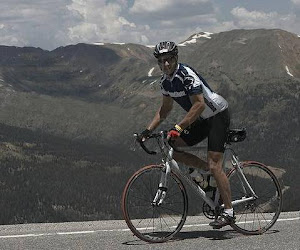
We're almost midway through January 2009 and at this point in your Annual Training Plan (ATP) you should be upping the volume of your rides (and intensity) in preparation for the high-intensity rides of February and March. There is NO EXCUSE for not getting outside and getting a longer tempo ride in. Besides, if you're like me and absolutely detest doing anything but shorter hi-intensity workouts on the trainer..there is no substitute for being outside in the fresh air. Who cares if it's cold and snowy..that's why they make darn good lightweight, warm clothing these days. And, the best part of riding outdoors this time of year, in the inclement weather, is that you really don't need to do it on the road with your road bike. This is a great time of year to grab a cross-bike, mountain bike or hybrid bike and look for those trails, dirt roads, etc. that are less traveled. Here's a ride that Jason Wood (photo above) and I went on today: we started in Stockton NJ and rode up to Stumpf Tavern Rd. on the canal path. Up Stumpf Tavern Rd. for a 1.5 miles on a 5% grade hill to Federal Twist Rd. Then, Federal Twist Rd. down to Quarry Rd. (dirt/gravel road) back down to the canal path at Bulls Island. From there, down to Lambertville NJ via the canal path, then back up to Stockton. Total Time: 2 hrs. Total Miles: 20 miles It was slow going, for the most part, but that's because of the 2 inches of snow that was already on the ground..not to mention the ice in spots. And, who cares if it was slow...I'll bet you that our average wattage for the 2 hrs. was close to 200 watts..so we got a great workout in. Well, at least it was an average wattage of close to 200 watts for Jason because he was pulling my fat ass for most of the ride. Thanks Jason.
So, get out there in the fresh air when you can..and find the trails/roads less travelled. You'll get a great workout and a jump on the 2009 bike (summer) season.
Monday, December 29, 2008
2x20s

Pronounced "two by twenties". So, what's so great about 2x20's? Well, if you're NOT doing these intervals you're probably NOT taking advantage of one of the best indoor/outdoor workouts for increasing Functional Threshold Power...especially if you do them at Level 4. I wouldn't recommend doing them without working up to them first. Either do 2x10s at L4 first or do the 2x20s at the Sweetspot Training Levels until you get in better shape. Here's what the profile should look like if you do them on the road. Notice that the first 20 minute interval was done just below my LTHR of 175 bpm. Also notice the Heart Rate creep...which is normal. The 2nd 20 minute interval exceeded my LTHR. Couple of things you shouldn't do..that you can see here: 1) do NOT take a 45 minute break between intervals like I did..that's WAY too much. However, to come to my defense, I stopped to grab a drink and ended up talking to a friend. And, 2) Don't let the Power on the 2nd interval drop more than 5% of the first. I was close on the second interval. BTW, if you do them inside, expect at least a 10% reduction in FTP power. Have fun!
Friday, December 19, 2008
Are you "Sweet Spot" Training?
During my weekly local "Power Advantage Program" training sessions I'm preaching/advocating Sweet Spot Training Intervals. Why? Because they work. i.e. they improve cycling performance. It doesn't take a rocket scientist to figure out that most of the physiological adaptations that are responsible for improve cycling performance are centered between the L2-L4 training zones/levels. Are you "Sweet Spot" Training? If not, you should be..because this is the PERFECT time of the year to be doing them.
For more information on Sweet Spot Training, please visit Coach Frank Overton's website: http://www.fascatcoaching.com/sweetspottraining.html
For more information on Sweet Spot Training, please visit Coach Frank Overton's website: http://www.fascatcoaching.com/sweetspottraining.html
The Perfect Pedal Stroke

The Perfect Pedal Stroke
How to get the most energy from each crank revolution.
By Loren Mooney
©TopDog Illustration
How to get the most energy from each crank revolution.
By Loren Mooney
©TopDog Illustration
Pedaling in a simple circle is a complex thing, but mastering it can save energy, says Todd Carver, biomechanist at Colorado's Boulder Center for Sports Medicine. He says that with proper ankling (shown here; not the injury-causing technique of the past), riders can churn out the same amount of power at a heart rate as many as five beats per minute lower. This stroke is for flat terrain at threshold, or time trial, intensity.Hip-Knee-Ankle Alignment Viewed from the front, your hip, knee and ankle should line up throughout the pedal stroke. "You don't want knee wobble," says Carver. "Just think pistons, straight up and down." If you can't correct this, or if you experience knee pain when you try to restrict lateral movement, you may need orthotics or another type of biomechanical adjustment.
Zone 1 Known as the power phase, the portion of the pedal stroke from 12 o'clock to about 5 o'clock is the period of greatest muscle activity. "A lot of people think hamstrings are used only on the upstroke," says Carver, "but a good cyclist uses a lot of hamstring in the downstroke, because it extends the hip." The key to accessing the large muscles in the back of your leg is dropping your heel as you come over the top of the stroke, says Carver. "At 12 o'clock, your toes should be pointed down about 20 degrees, but as you come over the top, start dropping that heel so that it's parallel to the ground or even 10 degrees past parallel by the time you get to 3 o'clock." The biggest mistake Carver sees in novice riders: not dropping the heel enough in Zone 1.
Zone 2 Using the same muscles as in the power phase, but to a lesser degree, this phase acts as a transition to the backstroke. "As you enter Zone 2, think about firing the calf muscles to point your toe," Carver says. As you come through the bottom of the stroke, the toe should be pointed down 20 degrees. "This ankling technique transfers some of the energy developed in Zone 1 by the bigger muscles to the crank," Carver says. He uses the advice popularized by Greg LeMond: "Act like you're scraping mud off the bottom of your shoe."
Zone 3 Even though you feel like you're pulling your foot through the back of the stroke, you're not. "When you look at even the best cyclists, they're losing power on the upstroke," says Carver. "The pedal is actually pushing your leg up, so the goal is to lose as little power as possible and get that foot out of the way." One fun way to improve the efficiency of your upstroke: mountain biking. "The terrain keeps you honest," Carver says. "If you're focusing only on the downstroke, you'll lose traction and fall off your bike in steep sections." As for other exercises, Carver advises against single-leg pedal drills--"for recreation-level riders, they injure more people than they help"--but recommends hamstring and glute-strengthening lifts, as well as squats, "done correctly, in a squat rack with someone showing you how."Saddle Position Proper bike fit, especially saddle height and fore-aft adjustment, is a prerequisite for a smooth pedal stroke. Without it, says Carver, you won't be even remotely as efficient as you could be. "If your saddle is too high, you're not going to be able to drive your heel effectively," he says. "If it's too low, you'll have knee pain." In the right position (knee over the ball of your foot with the pedal at 3 o'clock; knee slightly bent with the pedal at 6 o'clock), you'll maximize your energy output and also be able to adapt your ankling technique to different terrain, cadence and effort levels.
Zone 4 As you enter the second half of the upstroke phase, think about initiating your downstroke. "Many riders don't initiate early enough," says Carver, who often sees riders wait until 3 o'clock--but they should be starting before 12 o'clock. A tip: As you begin to come across the top of the stroke, think about pushing your knee forward, toward the bar. But only your knee, says Carver: "Your pelvis should remain a stable platform, not sinking down and not moving forward." As the knee comes forward, you should feel your hamstrings and glutes engage, and your hip extend.
Subscribe to:
Posts (Atom)